
HBCUgo: Scaling a Multi-Platform Streaming Ecosystem
Led the transformation of HBCUgo from a fragmented startup product into a unified, enterprise-scale fan platform across OTT, mobile, and web, focusing on product design and product strategy.
Platform: CTV / OTT / Mobile / Web
Date: May 2024
The Challenge
Scaling a fragmented streaming ecosystem into a unified fan platform
When I joined HBCUgo, the platform was at an inflection point—transitioning from a startup product into an enterprise-scale ecosystem under Allen Media Group.
Key challenges:
-
Fragmented experience: Streaming, CMS, and engagement tools operated as disconnected systems across OTT, mobile, and web
-
No engagement strategy: Pre-game, live, and post-game experiences lacked cohesion, limiting retention
-
Scaling pressure: The product needed to evolve without disrupting the fan experience
-
Stakeholder misalignment: Competing priorities across business, content, and engineering
My Role & Ownership
-
Led product + growth strategy across OTT, mobile, and web
-
Defined the engagement framework across the fan lifecycle
-
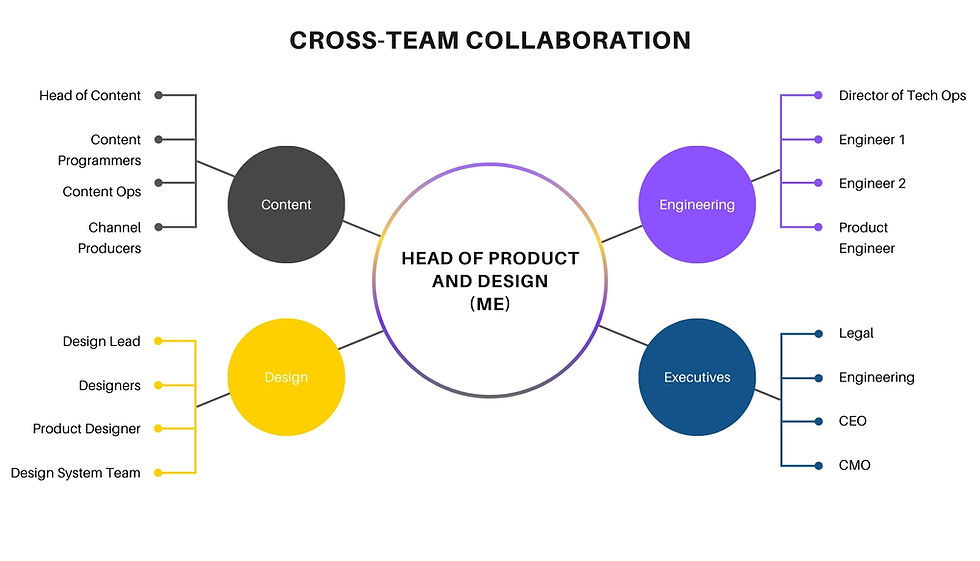
Aligned cross-functional stakeholders around a unified vision
-
Directed design execution across platform surfaces
-
Managed design + product owner teams


Legacy Experience: Fragmented Content Discovery
Content was organized for internal teams—not for how fans actually discover and engage.

HBCUgo Legacy OTT Design
Stakeholder Alignment & Strategy
My First Goal: Align Stakeholders
I realized early on that the team needed clarity and alignment to succeed in our transition. I created product and design roadmaps that outlined our vision, priorities, and timelines. I also established design standards and introduced design operations practices to improve collaboration between product, design, and engineering.
As a bridge between startup culture and the enterprise ecosystem, I defined governance frameworks and aligned cross-functional partners across various departments.
Through workshops and shared roadmaps, we developed a strategy to integrate the CMS architecture, live content operations, and fan engagement systems into a cohesive experience.
.jpg)
Mapping & Buy-In
-
I mapped the key stakeholders: AMG executives, content leads, engineering, marketing, and design. I facilitated workshops to align on fan engagement metrics, business goals, and technical constraints.
-
Created a vision brief and roadmap, showing how we’d unify streaming, CMS, chat/help, and engagement loops across platforms.
-
Introduced a design governance model to manage platform inconsistencies while integrating into enterprise standards.
Platform Strategy
-
Defined a multi-platform approach:
-
CTV / OTT (tvOS, Roku, FireTV): lean-back, passive viewing with engagement overlays.
-
Web / Mobile: interactive, discovery-first interfaces, community features, and seamless transitions into OTT streams.
-
Unified Back-End / CMS: a shared content and highlight engine across platforms.
-
Chat / Help / Support System: context-aware help flows regardless of platform.
-
.jpg)
“How I approached it”
.jpg)
-
Created product and design roadmaps to align stakeholders on vision, priorities, and timelines.
-
Defined design standards and systems for consistency, accessibility, and scalability.
-
Introduced design ops practices that streamlined collaboration between product, design, and engineering.
"What changed after"
-
Smooth Enterprise Integration: The design team transitioned seamlessly into Allen Media Group while maintaining momentum on product delivery.
-
Stronger Stakeholder Alignment: Roadmaps and standards reduced ambiguity, creating shared confidence across departments.
-
Scalable Design Function: Established a foundation of principles, systems, and rituals that allowed the design org to grow with the business.
-
User-Centered Growth: Ensured the app continued to resonate with students and alumni, even as it scaled into a broader enterprise offering.
“What I’d do differently”
Leading through this transition reinforced one of my core beliefs: design leadership is as much about culture and clarity as it is about craft. If I had more time, I would have invested even earlier in cross-functional onboarding and shared learning opportunities, so startup and enterprise teams could learn from each other faster.

Now that the stakeholders are aligned... rituals are set...
It's time to design...
Design Vision & Opportunity
What we executed on...
My Vision:
I reframed HBCUgo’s role from being “a sports app” to becoming a living fan ecosystem.
The opportunity was in creating cross-platform continuity—from pregame content and live streaming to postgame highlights and community re-engagement.
We leveraged auto-clipped highlights, chatbots, and contextual fan features to transform passive viewers into active participants.
My goal:
To transform HBCUgo from a static streaming product into a dynamic fan ecosystem—a place where culture, competition, and community meet. To achieve that, we focused on three key pillars of the experience:
1. Unity Across Touchpoints
Bridge the gap between live streaming, content discovery, and fan interaction. Every feature—from highlights to community chat—should reinforce the same story: connection. We wanted fans to move seamlessly from pregame hype to postgame conversation without ever leaving the app
2. Emotion-Driven Design
Celebrate the spirit of HBCU culture—the energy, pride, and rhythm that define these communities. Visuals, motion, and tone were built to evoke belonging and excitement, making every tap and transition feel like part of the game-day experience.
3. Intelligent Systems and Personalization
Use data and automation to make every fan’s experience feel tailored. Whether through auto-clipped highlights, in-app polls, or personalized schedules, our goal was to blend real-time insight with a human touch.
4. Scalable Foundations for Growth
Create design systems, components, and workflows that could scale with Allen Media Group’s enterprise infrastructure. This meant developing flexible UI patterns and robust design documentation to support both internal teams and future partners.


Fan Engagement
Designing the Fan Engagement Loop
1. Creating a connected fan journey across pre-game, live-game, and post-game experiences — turning passive viewers into active participants.
.jpg)
Our goal was to design an end-to-end fan ecosystem — where every tap, cheer, and share fuels the next moment of engagement. By aligning content, data, and design across pre-game, live, and post-game touchpoints, HBCUgo transformed from a streaming platform into a connected fan community.
“We designed a multi-phase experience that mirrors the rhythm of HBCU culture — from the first hype post to the final recap.”

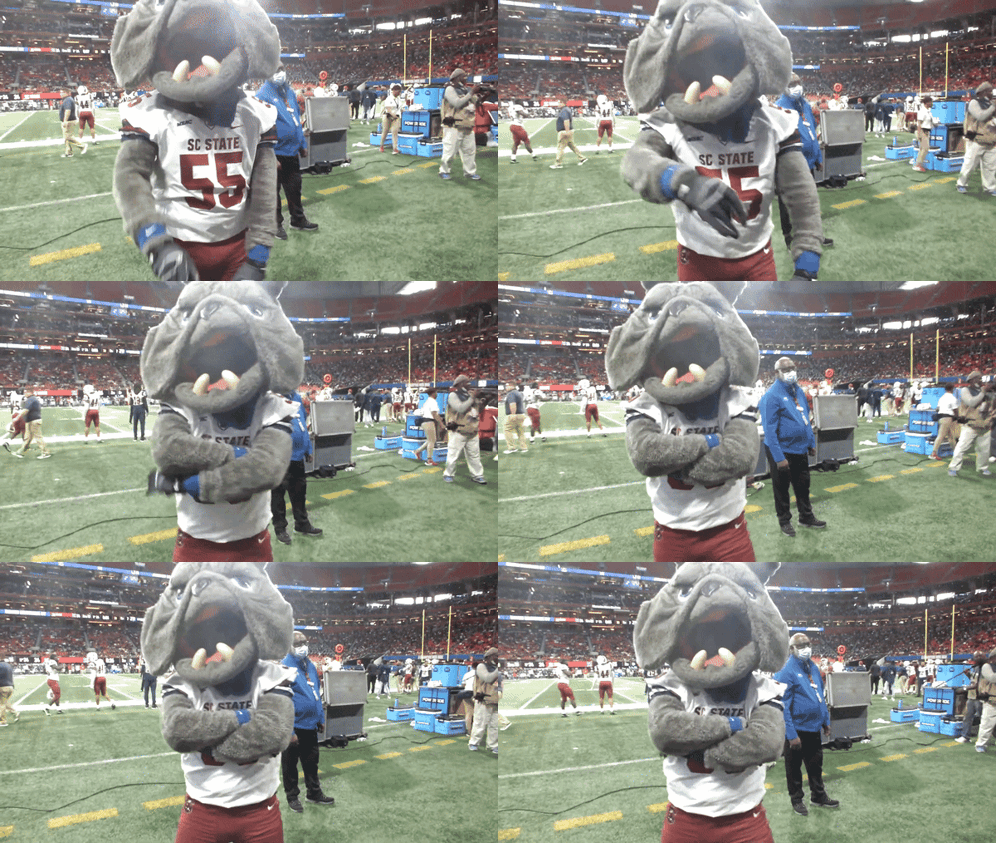
Designing the Real-Time Fan Experience
Integrating live data, storytelling, and interaction to keep fans connected before, during, and after the game.
The redesigned HBCUgo Fan Experience focused on creating real-time engagement through data-driven interaction and storytelling. I designed mobile interfaces that connected fans to every moment — from pregame reminders and live updates to post-game highlights and replays — transforming passive viewers into active participants.
Each component was crafted to drive emotion and connection:
-
Pregame reminders built anticipation and boosted tune-ins.
-
Live play cards offered real-time game insights, bridging broadcast and digital.
-
Post-game summaries celebrated teams, stats, and fan conversation loops.
This ecosystem was powered by a modular design system that could scale across mobile, OTT, and web — aligning with Allen Media Group’s enterprise content strategy.

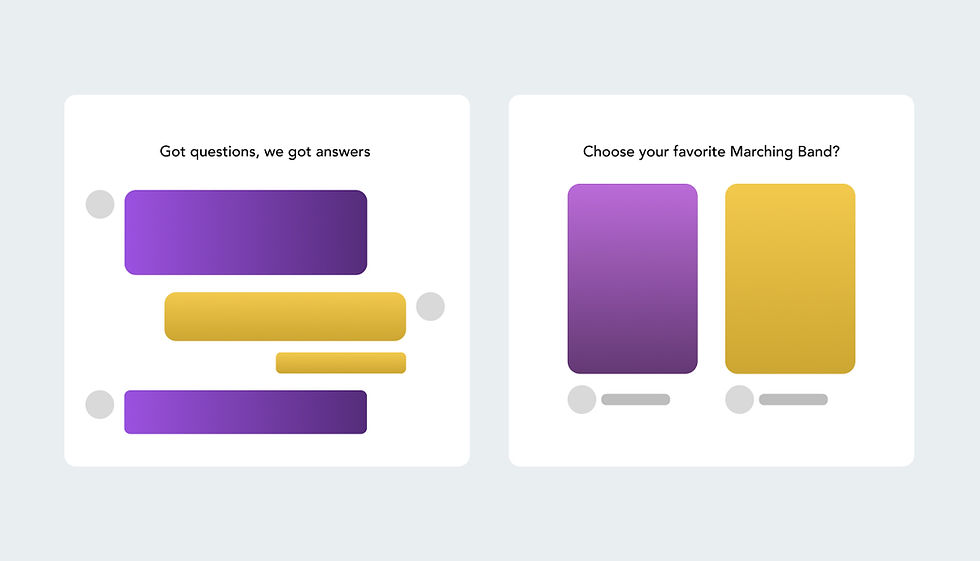
Designing the Live Game Experience
Building continuity between pre-game conversation, in-game data, and post-game highlights.
The Live Game Experience was designed to bridge the energy of broadcast television with the interactivity of digital sports platforms. My goal was to make fans feel connected, informed, and part of the game — no matter where they watched.
From real-time play-by-play updates and live score tracking to on-demand replays and community discussions, every feature was designed to extend engagement beyond the field. The interface balances clarity and excitement, using motion, hierarchy, and bold typography to deliver fast information without losing emotional impact.
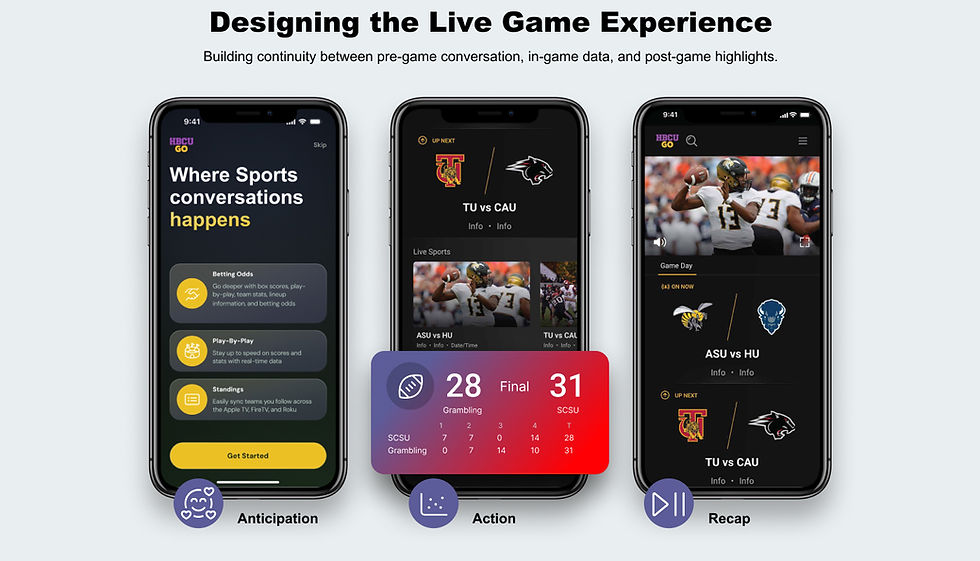
Pre-Game → Live Game → Post-Game
Each phase represents a key fan behavior moment — before, during, and after the game — supported by targeted UX features and real-time media integration.
.jpg)
Unifying Design Across Platforms
The Fan Engagement Loop was built on scalable components that extended to mobile, web, and connected TV, ensuring consistency in look, feel, and function across devices.


On-Demand Experience
We created the ultimate fan experience with On-Demand community content.
Market Research Insight
Understanding the Streaming Landscape
Based on our research, we discovered that HBCUgo’s core audience engaged with a mix of live sports broadcasts, campus culture content, and student-led media across multiple streaming platforms. To better understand their viewing behaviors and expectations, we analyzed competitor OTT apps popular among HBCU students—such as ESPN+, Peacock, and YouTube TV—as well as social video platforms like Instagram Reels and TikTok.
Our findings revealed that fans valued authentic storytelling, real-time connection, and ease of navigation, with a strong preference for platforms that allowed seamless transitions between live games, highlights, and community-driven content. These insights guided our design direction toward a more unified fan experience—one that blends entertainment, culture, and accessibility within a single ecosystem.

Execution & Project Management
Project Strategy
I led the creation of a unified design system adaptable across OTT (Roku, FireTV, tvOS), mobile, and web. Key work included:
-
Redesigning streaming UX and navigation across devices.
-
Architecting Pregame → Live → Postgame → Re-engagement journeys.
-
Embedding DesignOps rituals (crits, retros, async reviews) to scale efficiently.
-
Building out accessibility and cultural expression in visuals and interaction models.

Building the Foundations
-
Created a design system with adaptive UI elements—responsive grids, component variants, platform-specific skins (tv, mobile, web).
-
Documented platform constraints (tv remote navigation, lean-back vs lean-forward interaction) and incorporated them into component rules.
End-to-End Flow Design
-
Designed unified user journeys:
-
Pregame: notifications, previews, lineup stories
-
Live / In-Game: streaming + engagement overlays (polls, stats, chat)
-
Return Engagement: reminders, loyalty prompts, content browsing
-
Postgame: highlight clips, recaps, social sharing
-
-
Prototyped and tested cross-device flows: e.g., user taps a highlight on mobile, continues watching it on TV.
-
Designed the chatbot / help system to detect platform context and shift accordingly (if on TV, minimal UI; if on mobile/web, richer help UI).
Integration & Transition
-
When HBCUgo merged with Allen Media, I led the design ops integration: migrating UI patterns, aligning branding, and onboarding new teams.
-
Held design reviews, retros, and “design syncs” across startup and enterprise teams to maintain momentum and clarity.
-
Introduced versioning, internal style audits, and design governance to scale reliably.
Project Cadence & Delivery
-
Used agile sprints, OKRs tied to fan metrics (retention, repeat sessions, highlight shares).
-
Prioritized features via frameworks (impact vs effort, fan value vs technical feasibility).
-
Led weekly cross-functional demos, stakeholder walkthroughs, and roadmap re-alignments.
Visuals
Connected Experience
The main highlight of the new HBCUgo Experience was connecting mobile, web, OTT, and CTV viewing into a fun and engaging fan experience. It made it super easy for our members to check out entire classes!


New ways to search content


A redesigned search experience that surfaces live games, highlights, and campus stories instantly, helping fans spend less time searching and more time watching.
Enhanced Viewing Experience


The redesigned hero and viewing interface brings live games, replays, and cultural moments to the forefront — immersing fans in the action from the moment they open the app.
Interactive Prototype for the New Web Experience
Next Steps
v1 was Just a Beginning
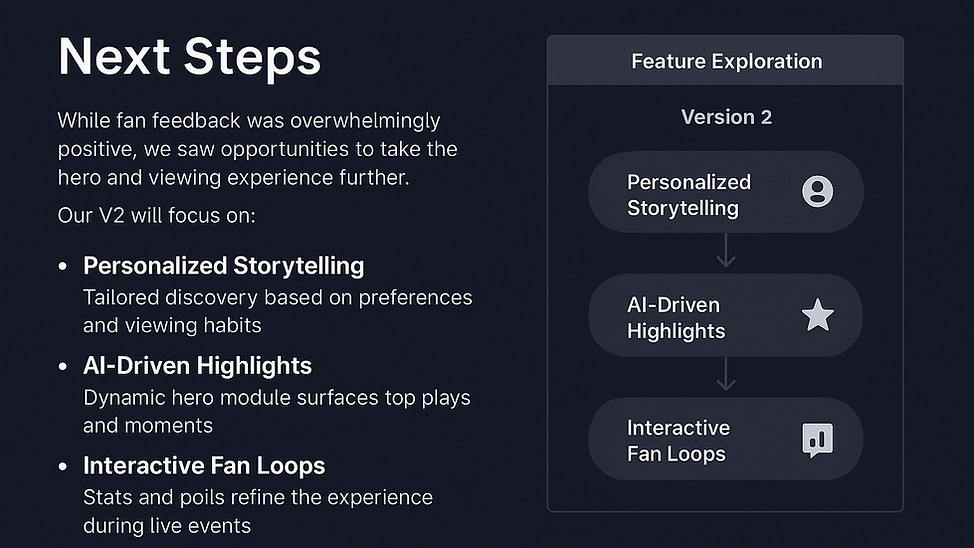
While fan feedback around the new hero and viewing experience was overwhelmingly positive — with higher engagement times and smoother transitions across devices — we saw an opportunity to take the experience even further.
Our next iteration focuses on personalization and live interactivity. Data showed that fans who tuned in during pregame moments were more likely to stay through halftime and postgame recaps. To build on this, we’re exploring ways to make the hero adaptive — surfacing live stats, trending highlights, and fan-driven content dynamically across CTV, OTT, and mobile.
Version 2 will focus on deepening retention through contextual storytelling, AI-driven highlight curation, and interactive fan loops — transforming HBCUgo from a streaming platform into a living, breathing community experience.
Designing the Lifestyle & Entertainment Experience
Building a scalable workflow and interface to showcase series, films, and original content shot by our in-house production team.
As HBCUgo expanded beyond live sports, we needed a unified platform that could flex between fast-paced game coverage and cinematic storytelling. I led the end-to-end design strategy for our Lifestyle and Entertainment vertical—developing a modular workflow for content ingestion, metadata tagging, and multi-device playback.
The new interface elevated our editorial content—spotlighting series, documentaries, and cultural programs with dynamic hero modules, adaptive carousels, and genre-based discovery paths. The result was a content experience that felt as vibrant and intentional as the stories we were telling—bridging sports, culture, and community through design.

Impact & Reflections
Final Remarks
Impact
-
After launch, we saw 20–30% lift in repeat viewership across platforms.
-
Connected viewing experience drove a doubling of shareable clips among fans.
-
Chatbot and help reduced support friction, especially on mobile/web transitions to OTT.
-
Smooth acquisition integration — fans experienced fewer disruptions, and legacy HBCUgo brand equity was preserved.
Reflections & Learnings
-
Platform-first thinking is essential. A design that works beautifully on mobile may fail on TV; each platform demands its own nuance.
-
Bridge roles matter — being the interface between startup culture and enterprise structure is as much about empathy, communication, and process as it is about design.
-
Scalable systems save time — we invested early in a system that reduced duplication and made iteration faster.
-
Fan engagement is relational — to keep fans, designing emotional touchpoints across time (before, during, after) matters more than isolated features.
